%20Christi%20Gmyr%20Logo%20%26%20Assets-09.png)
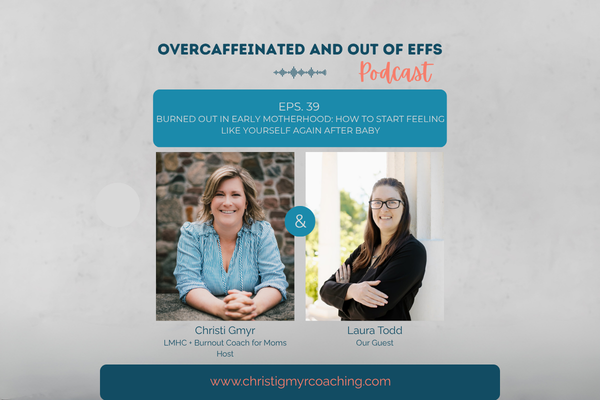
EPS 39. Burned Out in Early Motherhood: How to Start Feeling Like Yourself Again After Baby
In this episode of Overcaffeinated and Out of Effs we're talking about the kind of burnout that shows up in early motherhood – something no one really prepares you for. I'm joined by licensed therapist and mom of two, Laura Todd, who specializes in maternal mental health and early childhood. She shares both her professional insight and personal experience navigating burnout after becoming a mother including the identity shifts, value conflicts and pressure that so many women carry.
If you've ever asked yourself, “I love my kids...but why does this feel so much harder than I expected?” then this episode is for you. It will help you feel less alone while giving you the practical tools to start feeling like yourself again.
Together we talk about:
Why burnout is so common in early motherhood
The difference between postpartum mental health struggles and maternal burnout
One thing most people don't understand about burnout
Nervous system regulation strategies for overwhelmed moms
Small, realistic steps you can take to begin recovering your energy
Daily or weekly practices to help you prevent your burnout from getting worse
Common beliefs about motherhood to unlearn that will help you feel better
Laura reminds us that feeling burned out isn't a sign that you're failing and it definitely doesn't mean you're a bad mom. It means you're human and you're navigating one of the biggest identity shifts of your life without nearly enough support. And there is a way forward.
Find Laura at:
Early Bonds Therapy
Website: www.lauratoddlpcc.com
Social Media: @the_infant_therapist
[00:04] Christi Gmyr: Welcome to Overcaffeinated and Out of Effs, the podcast for burned out, career-minded moms who are ready to stop pretending everything's fine and feel like themselves again.
[00:15] I'm your host, Christi Gmyr, burnout coach for moms, licensed therapist and mom of two. And I'm here to help you reclaim your energy, your identity, and your peace of mind.
[00:25] Whether you're lying awake thinking about the 87 things you didn't get done or silently resenting the people you love most,
[00:32] This is your space to feel seen, supported, and not so alone.
[00:36] So grab your coffee, hot, cold or day old, and let's get into it.
[00:48] Hey everybody, it's Christi.
[00:50] Welcome to Overcaffeinated and Out of Effs. In today's episode, I'd like to welcome our guest, Laura Todd.
[00:57] Laura is a licensed therapist in Silicon Valley.
[01:00] She has additional certifications in infant and early childhood mental health and perinatal mental health.[01:06] She started her career as a community therapist for a local nonprofit providing services to families with children birth to 5 years old.
[01:15] When she had her first child in 2021,
[01:18] she quickly realized that the nonprofit career did not align with her values as a new mother.
[01:23] She opened her private practice, early bonds therapy in January 2024,
[01:28] focusing on helping mothers find joy in their motherhood. From fertility all the way to parenting in the early childhood years.
[01:36] When Laura isn't running her practice, you can find her playing trains and cars with her two young boys, reading, cross stitching or trying to keep up with current movies and TV shows.
[01:46] So I've invited Laura here today. She's going to share a little bit about her personal story story as you know, a burned out working mom herself. And she's also going to share a little bit about, you know, her expertise in maternal mental health,
[01:59] specifically around postpartum and parenting in early childhood.
[02:04] She has a lot of experience helping burned out moms as they navigate parenting in the postpartum period and the early years of their lot of kids lives.
[02:12] So I'm so, so excited to have her here today.
[02:17] So Laura, thank you so much for being here.
[02:20] Laura Todd: Thank you so much for having me. Yeah.
[02:22] Christi Gmyr: Do you mind just starting off by telling us, you know, a little bit about yourself, so maybe a bit more about the work that you do, your own journey to where you got to where you.
[02:30] You are now. You know, those kinds of things.
[02:33] Laura Todd: Yeah, absolutely. So as mentioned in my bio, I was a community mental health therapist working with families with children birth to five.[02:42] What that essentially looked like in reality is I would actually commute to people's homes within the South Bay area of San Francisco Bay area and do therapy in people's homes with their child and their primary caregiver together.
[02:56] This is what we would call dyadic therapy. Two people together in a room, which doesn't look like a lot of traditional therapy models.
[03:04] And a lot of the work I was doing with these kids was dealing with trauma, dealing with developmental milestones or developmental delays,
[03:12] dealing with child behavioral issues like tantrums, hitting, fighting,
[03:17] dealing with a lot of attachment issues between primary caregiver and that child and sort of the family system as a whole.
[03:26] As you can imagine, that's a lot of intense work.
[03:29] It was a lot of fulfilling work. I really, really loved it. I've always loved working with kids. Birth to 5 is the population I love to work with.
[03:37] And so I really loved that job for many, many years.
[03:40] Um, I was,
[03:40] I was hired on as a therapist originally. I got promoted to the lead of my program a few years in, and then I became a supervisor at the end of that.
[03:50] And so when I made that switch to private practice, it was actually when I was a supervisor and I was just really burnt out on the demands that were being made of me as a supervisor from my upper management and the county who was funding us.
[04:04] And also the demands of my staff being like, we're burnt out, we're overwhelmed, you need to help us. And it's like my hands are tied. I can't do it,
[04:11] do anything as a middle sort of manager. And I was coming home completely burnt out. And I had a, at the time, a one year old, one and a half year old,
[04:21] and just couldn't show up for him anymore.
[04:24] And so my husband and I were starting to have this conversation of like, hey, we're both really burnt out on our jobs. My husband works in tech at Google,
[04:32] as you can imagine, a very high stress job.
[04:35] And so we were just like kind of starting to have this conversation when one Saturday my husband decided,
[04:43] hey, you're really burnt out. Let me take our kid to the park. Give you a break. You know, just really being a very supportive husband and just trying to help me out.
[04:51] Um, we have a park that's within walking distance of our house. And so he took our child there. And about maybe 20 to 30 minutes into this outing, he sends me a text, I have to come home.
[05:03] I've tweaked my back to add context to that situation. Oh, no.
[05:07] Christi Gmyr: Yeah.
[05:08] Laura Todd: My husband was in the military before he met me.
[05:11] He was in the military for three Years. And he got out of the military because he got a back injury that made him an undeployable soldier, even though that wasn't his job in the military.
[05:20] His job was in, like, military intelligence.
[05:24] But at the time, the military would not keep you on if you were not able to be deployed if they needed you to.
[05:30] And so we're very conscientious of, like, taking care of his back. He, you know, does what he needs to do to manage it.
[05:35] Um, so you imagine when a tweaked back comes up for us, that sends us into, like, okay, what do we need to do to make sure that this doesn't become worse?
[05:42] Um, that recovery from that back injury took three weeks.
[05:46] So in an attempt of my husband trying to help me to deal with my burnout, I actually end up being more burnt out because now I have three weeks of solo parenting on top of my job.
[05:57] And I just said, we can't do this anymore.
[06:00] Like, there's just no way that I can risk you trying to help me out,
[06:04] injuring your back again, or worse, having to go back into surgery again because I'm too burnt out at my job and can't show up at home with our kid. And so we just decided, all right, this is it.
[06:16] My job is much easier to shift than yours. And that's when we said, okay, let's go to private practice. Let's try this out. Let's dip our toe in and see what the world is like, where I can control my schedule a little bit more.
[06:27] And the time that I'm using at work, and it's been a really wild ride, but it's been really exciting, and we've been really loving it ever since.
[06:38] Christi Gmyr: That is. That's amazing, right, that you. You know, you guys were having these challenges that you were able to have these conversations. It's. I think it's fantastic that you have a supportive partner.
[06:49] Right. Because,
[06:50] as we know, love.
[06:52] They're varying degrees of the support that all moms sort of receive, you know,[06:56] and that you were able to.
[06:58] To make that pivot. You know, one of the things that I really encourage moms to think about, you know, I know one of the things that happens a lot when our kids are born, when we start having kids, is that we do have to sometimes reevaluate what those career paths look like,
[07:11] because suddenly we have a whole new focus,
[07:15] and what was working before might just not be working anymore. So I think that that's amazing that you did that. And that's what we were talking about before we even started, like,
[07:24] I had a very similar journey in terms of how I got into private practice. And so I just. I think that that's amazing that you did that,
[07:30] and I could really.
[07:32] I can really understand and relate to that. So you mentioned, though, being burned out, and obviously a lot of the moms who are listening are,
[07:39] and that's a word that people use a lot. But I'm curious, you know, more specifically, how,
[07:46] like, how did you know that you were burned out? What did burnout look like for you,
[07:50] day to day as a new mom?
[07:53] Laura Todd: Yeah,
[07:54] it's definitely a big term that's thrown around, but, like, what does that really mean? What does that look like in practical terms? Yeah,
[08:02] I think the big one is the chronic exhaustion. It doesn't matter how much sleep you get,
[08:08] you're still really tired.
[08:10] I was definitely feeling a lot of that.
[08:12] Um, even when my baby slept through the night, I was still super tired the next day.
[08:16] Um, I was constantly feeling like I was playing catch up. Like, I could never get ahead of something that was going on at my job or something that was going on with the house.
[08:25] It just chronically felt like I was behind all the time.
[08:30] Um,
[08:31] there were times I really felt like I was just going on autopilot and not really feeling like I was present or at home or,
[08:38] you know, at my job. I just was just going through the motions and not really feeling like I was living, you know, and enjoying my life the way that it had been set up.[08:46] And then, of course, I think a lot of moms can relate to this. A lot of guilt and shame about splitting my time, feeling like I wasn't there for my staff when they needed me and was failing to sort of show up there, but also feeling like I was failing at showing up for my baby.
[09:01] You know, just all this guilt when I was,
[09:04] you know, at home with him because he was sick. And so I felt guilt that I wasn't supporting my staff and had to kind of leave them in the lurch suddenly because I was the one that could more easily drop everything and pick him up and take care of them.[09:15] And then also feeling guilt when I was at work and I was not with my baby and, you know, not always there for every single moment with him.
[09:23] And so those were a lot of the. The feelings I was having for. Burnt out.
[09:29] If I go back and really remember, I'm sure I was probably really irritable, too. Really,[09:33] like, not a lot of patience.
[09:35] Christi Gmyr: Yeah.
[09:36] Laura Todd: Either for my child or for my.
[09:38] For my partner. Like, we were just. I was just not in. What they would say is, like, happy, go, lucky, bubbly. Laura was not present anymore.
[09:46] Um, and so it really felt like I wasn't myself anymore. I just didn't feel like I was me and living as myself day to day.
[09:53] Christi Gmyr: Well, and it sounds like from what you were saying before that, you know, you were experiencing all these emotional challenges. The exhaustion, that lack of patience, the irritability, all those things.
[10:02] But it was really your husband who sort of pointed that out to, like, hey,
[10:08] like, we need to do, like, we need to talk about this. We need to figure out what can be different. Because it seems like we are both burned out. So it sounds like.
[10:15] And I think a lot of times,
[10:17] you know, with moms, we're just going, going, going all the time, and we think that this is just normal, this is what is expected.
[10:24] And a lot of times, I don't know that we always recognized when we're,
[10:29] like, when we've reached our limits or when we've passed those limits.
[10:32] And it sounds like maybe there was a little bit of that going on for you, too.
[10:36] Laura Todd: Yeah,
[10:37] a little bit. I think the other thing,
[10:40] to add more context to the situation. My husband had been wanting me to go into private practice for years because he was so annoyed at how much my company was asking so much of me again,
[10:52] bless his heart. He's such a wonderful man.
[10:54] He knew not to push me into one direction too hard.
[10:59] He was like, just know that, like,
[11:01] Christi Gmyr: private practice is always there.
[11:02] Laura Todd: You're like, whenever I, like, come home.
[11:05] Yeah. Oh, gosh, I hate this job. Like, I'm so stressed. Us, like, oh, my God, can you believe this thing that happened? And he'd be like, yeah, but, you
[11:11] Christi Gmyr: know, you could always just go to private practice.
[11:13] Laura Todd: He would just kind of slowly, like, do these little hints, but never push me. And so I think when this situation came up, he was like, okay, let's really think about this now,
[11:21] because this is not sustainable, what we're doing. And so it was kind of already planted in my head that that could be a possibility.
[11:28] But, yeah, he's a really great, supportive husband.
[11:31] You know, we have our challenges as any couple, any family does, but at the end of the day, we really try to be mindful of where the other person is at and try to show up for each other so that we can be the best parents that we can be to our two little ones.[11:45] That's awesome.
[11:47] Christi Gmyr: Well, and then, so you were talking a lot about, obviously, the emotional challenges, you know, feeling guilt and whatnot what about logistical challenges? You know, some of the biggest challenges in that sense as a new mom, because, you know, we've all heard the saying, we're expected to work as though we don't have kids and parent as though we don't work when it's.
[12:07] It's like two full time jobs. So that's a lot to manage. And so I'm wondering, what were some of those things that you found especially hard?
[12:16] Laura Todd: I think the biggest challenge I had was prioritizing my time when I was at work and prioritizing my time when I was at home.
[12:26] There's just a new level of what do I need to get done in the time that I have available.
[12:32] When you have a kid at home,
[12:34] that's very different than when you sort of like, oh, I can get home at 6, I can get home at 7, I can just keep working.
[12:41] No, I gotta pick up my kid at five. Like the nanny's clocking out at that time, or, you know, childcare ends at five. I need to. This is the amount of time that I have, and this is what I need to get done in that time.
[12:50] So learning that takes a new set of skills, you know, to figure that out. If you're not used to. All right, this is how I'm prioritizing my time.
[13:00] And I think being able to split the focus when your day is disrupted, like, there's just more disruptions to your day than you're used to. You know, when you're working as a single person or even just as a couple with no kids,
[13:12] you don't generally get a call in the middle of day being like, hey, you got to go stop everything and do this thing.
[13:17] I would, you know, have a kid at home, he'd be fine, look, great. I go to daycare, I drop him
[13:22] Christi Gmyr: off, I go to work.
[13:23] Laura Todd: I'd start my day two, three hours later, I get a phone call, hey, we've got a fever. You got to pick him up.
[13:27] No warning.
[13:29] This just happened. It's just like, all right, drop everything,
[13:33] go. And I think that was a really hard shift for me. And even to this day is still kind of hard because,
[13:39] you know, I get into a flow on my website or, you know, I've got six clients, not six clients. I don't actually see that many. But like, I've got a list of
[13:46] Christi Gmyr: clients that I'm seeing.
[13:48] Laura Todd: You know, both my kids are fine. I send them off to, you know, their childcare and then I get a call saying, hey, one of them's got to be picked up.
[13:55] They can't stay anymore because they've got a fever, they've got something going on that's health wise that they need to be brought home to. And of course I'm always happy to take care of my kids if they're sick and they need me.
[14:06] But there is still a sense of it's still stressful,
[14:08] it's still stressful and there's still a sense of disappointment, like,
[14:11] oh my God, I had all these plans of what I was gonna do today and now that's just out the window. And so one of the biggest things I learned was how to give myself grace in those moments and not have to put pressure on myself of I need to get ahead,
[14:25] I need to get to this next thing.
[14:27] And said, you know what, it's okay. Like,
[14:29] baby needs me right now, baby's got a fever, baby's got something going on that they just need me to take care of them.
[14:35] I will get to that thing eventually. Like, I can get that down the road. And that took a long time for me to shift to that mindset of I don't need to race to the next thing, I don't need to achieve the next thing.
[14:46] I can get there in my own time. And being a mom, building a business,
[14:51] it's just a process, it's a journey, it's gonna take time and it's going to be a slower amount of time than someone without kids.
[14:58] My 24 hours is very different from, you know, single growing business. And they're 24 hours.
[15:05] And that's okay.
[15:07] Christi Gmyr: Yeah, no, absolutely. And I have always said, you know, my personal opinion or my personal experience has always been that sick. For me, dealing with sick kids is one of the hardest things, if not the hardest thing about being a working parent.[15:20] And I'll even expand that a little bit. To your point, maybe it's not just sick kids, but just these unexpected things that come up that you were just sort of expected to suddenly drop everything that you had planned for the day,
[15:32] suddenly pivot, readjust, come up with a new plan,
[15:35] like on the spot. And that is that I have always found to be like one of the most stressful things. And I think that it's something that all parents, all working moms, can relate to because all kids get sick.
[15:47] You, you know, you talk about daycare and they seem to get sick more, especially at the beginning of daycare, you know, so, yeah, that's. But to your point, like these things that you have to do, they'll still be there later.
[16:00] You know, unless it's something that has a really specific deadline, which most things are not that emergent. Like, most things can wait and you can come back to them later.
[16:11] So. Yeah, no, that. That absolutely makes sense. So when you're talking about the work that you do, right, because you work with a lot of moms, right, Especially with your primary focus as, you know, as a therapist with the.[16:23] With. With the babies and the little kiddos,
[16:27] why do you feel like burnout is so common for moms, especially in the early years, right after having a baby?
[16:37] Laura Todd: Oh, gosh, yeah.
[16:39] I think for many of us coming into motherhood right now, most of us are,[16:43] you know, millennial. Older, millennial,
[16:45] generic millennial. Maybe some Gen Xers.
[16:50] I don't know where time is anymore in terms of ages are anymore. I'm seeing a lot of people that seem a lot younger than me.
[16:57] Christi Gmyr: When they're like, no, we're in our early 30s.
[16:59] Laura Todd: I'm like, but you're born in, like, the 90s.
[17:01] Christi Gmyr: Like, what?
[17:03] Laura Todd: I think a lot of us, when we were growing up, we came into the generation of girl power.
[17:08] You can do anything. Messaging. If you put your mind to it. If you work hard enough, you'll get there.
[17:13] And so we learned this idea of if we push ourselves hard enough, if we push ourselves through school,
[17:20] through our hobbies,
[17:22] we get a reward at the end. We get good grades, we get certificates, we get trophies. And so we've learned, oh, if I just push hard enough, if I just try hard enough, it's hard.
[17:32] But if I just get to the end, like, I'll achieve my goal.
[17:36] And then we brought that same.
[17:38] Sorry, excuse me.
[17:39] They brought that same method to their careers. You know, we work really hard, we push through our tasks, we push through our deadlines, and then we get rewarded again with promotions, with bigger raises,
[17:52] and then we become a mom.
[17:54] And we think, same logic. If I just push
through this tough phase with my child, if I just push through this period,
[18:01] I'll get the reward at the end.
[18:03] The problem is there is no reward at the end.
[18:06] Maybe you'll feel it 18 years down the road when you've, like, I raised an adult, great, I can launch them. But even then, you're still a mom with adult children who will still probably hopefully come to you with needs.
[18:20] Maybe not as much as when they're a newborn,
[18:22] but that immediate gratification is not there. And it just keeps going. It's.
[18:28] It feels endless. Of course, everything ends at some point, but because raising a child is a long game it's the idea of pushing through doesn't actually work. And you need to actually slow down and figure out, how can I sustain myself through the long slog of sleepless nights, teething,
[18:49] tantrums,
[18:51] you know, disruptions to my day,
[18:54] you know,
[18:55] navigating their friend group, teaching them how to drive, all these different milestones that are struggles throughout motherhood because they're just going to keep coming. It'll just look different as they get older.
[19:07] Christi Gmyr: Well, yeah. And absolutely. And you know, to your point, one of the, you know, when we talk about stress and burnout, a lot of those words, times those user, those words are used interchangeably, but they are a bit different in terms of what they actually are and look like.
[19:21] And just regular stress,
[19:23] it is short term, it's temporary, it's situational. It's okay. To your point, like, let's just push through this week, Push through this, you know, assignment, push through whatever this thing is, and then it will be done and then, you know, I can relax or move on to something else.
[19:37] Whereas burnout tends to stem from,
[19:40] like this chronic stress that just keeps on going. And it's not like it's not situational. And so it's really hard to.
[19:50] To kind of move, like, step away from it in the same kind of way. Like, because to your point, parent. Parenthood is. It's a long game and it is, you know, once we have kids, they're there hopefully for life, you know, so.
[20:02] So yeah, it's just. Yeah. Kind of the other layer to that,
[20:06] Laura Todd: too that is not sort of directly mentioned is all of these tasks that are. You said situational are all innate objects. Essentially. School is a concept. Hobbies are an activity like that.
[20:19] You just do and are done.
[20:22] Being a parent, you are in relationship with another human being that has their own thoughts and feelings and opinions.
[20:30] Christi Gmyr: Yeah.
[20:30] Laura Todd: And you can't push through to get to the point to force another human being to get to the goal that you want them to get to because they will have their own opinions about how they want to get there.
[20:43] Anyone who's raised a toddler will know that that toddler has a lot of strong feelings about a lot of things.
[20:49] Christi Gmyr: Oh, yeah.
[20:50] Laura Todd: And so you're left with no tools of like, well, pushing through is not working. What. What am I supposed to do? And so then you're sort of left in this feeling of, I'm helpless,
[20:59] there's nothing I can do. And so you're trying to scramble to figure out how do I get my toddler to brush their teeth how do I get them to eat their food?
[21:09] They're not responding to me, just forcing them and pushing them through. And that's a lot of the conversations I have with these moms that I work with where they're, you know, sleep deprived because their newborn isn't sleeping.
[21:20] They can't force their kid to sleep.
[21:22] You know, that's just not reality. And yet they don't know how to deal with it because they just, they don't know what they're supposed to be doing because no one's taught them how you put a newborn to sleep or how you put a young infant to sleep.[21:33] Or I'll have a second time mom come in with a newborn and a toddler and they're like,
[21:37] how the hell do I manage a newborn and a toddler who is,
[21:41] you know, screaming and tantruming at me? And I can't push through to make them do what I need them to do to get through the day?
[21:49] Christi Gmyr: Well, and all kids are different, right? So some kids, it's. I mean, you're talking about parents maybe not being taught these things, which, you know, is abs. Absolutely makes sense. But then also this other piece of.
[22:00] It's not like there's one specific process to get your kids to sleep. There are strategies and tools that can help different things that people have, you know, that work. But at the end of the day,
[22:11] some kids are going to sleep through the night much, much sooner than other kids. And it's not something that we can,
[22:17] we can maybe influence in some. Influence it in some ways, but. But not control it.[22:22] Laura Todd: Exactly. Absolutely. So that's why when I have parents come into my practice, I tell them, look, I am not somebody who is going to say X, Y and Z is what you absolutely have to do for parenting.
[22:34] Because I don't know your kid, I don't know what's going to work for your kid. Because what works for one kid is not going to work for another.
[22:40] What I will do is I will sit here and talk you through. Here are some options.
[22:44] What are these options that work as a value for your parenting, that align with that and also work for the type of kid that you have?
[22:52] Christi Gmyr: Because a tool that I would give
[22:54] Laura Todd: to a parent with an easygoing temperament child looks very different than the tool I would give to a parent with a child with a slow to warm temperament or a difficult temperament.
[23:04] I hate that term, difficult temperament.
[23:06] These are just kids that, you know, it takes a little bit more.
[23:10] And that's not a bad thing. It just means you have to Have a different lens with how you interact with that child. And so that's why I don't really prescribe to the, you know, hire me and I'm going to give you my 10 steps that will solve all your problems with your children.
[23:23] Because I don't know who your child is.
[23:25] You know who your child is. You have to come and tell me. And then from there, based on my, you know, experience, my expertise and the research that I know,
[23:33] let's talk through. What are the tools that I'll actually
[23:36] Christi Gmyr: work for for you?
[23:37] Laura Todd: Work for your child and align with your parenting values. And I think that's another topic that isn't really talked about a lot in parenting is what are your values as a parent and how does that show up in the parenting that you are providing to your child too?
[23:50] Christi Gmyr: Yeah, yeah, no, absolutely. So what do you think are some, like some things or maybe one thing that maybe most people don't really understand about burnout?
[24:03] Laura Todd: I think one of the things that people don't really understand about burnout is that it's not just being tired, it's not just being overwhelmed.
[24:15] Christi Gmyr: Yeah.
[24:16] Laura Todd: It's a fundamental like nervous system breakdown essentially is what burnout is. It's not something that can just be fixed with a bubble bath. Yeah.
[24:27] Which is sort of the,
[24:29] I would say, the wider society image of burnouts, like take a bubble bath, go get a massage, go get your nails done. These are all things that are very nice to have if you have the funds for it.
[24:37] And yes, they can help with maybe small amounts of burnout. But with moms,[24:43] there's a chronic like nervous system overwhelm and that can't be fixed with just a once a week, once a month event. It's really a full system set up that needs to be supportive in regulating that nervous system and doing it in community and support.[25:00] Yeah, I was. I don't know if you're familiar with Dr. Bruce Perry. He's a well known psychologist that does research in trauma in childhood. I did trainings with him and got trained in his neurosequential model of therapeutics many, many years ago.
[25:16] One of the things he taught me that I think not enough parents and people know about is that biologically when we were raising our children,
[25:24] it was four adults to every one infant.
[25:28] Could you imagine a world today in a household where there are four adults to every one child and how much that would reduce burnout and overwhelm for mom? Yeah.
[25:38] Christi Gmyr: That is not how most people experience
[25:41] Laura Todd: parenthood,
[25:42] not at least in the United States, I think there are countries where that is more the norm.
[25:47] In Silicon Valley, we have a lot of,
[25:50] um,
[25:50] families that are in, you know, part of the immigrant community.
[25:53] India, China,
[25:56] Thailand, you know, they come from all over. And a lot of them do have some of that generational family support. But again, I think in sort of generic American society, that is not the norm.
[26:05] In fact, we were sort of told, like, it's a nucleus family or bust, it's two adults. That's the perfect format for raising children.
[26:12] But really,
[26:13] in the biological sense, it's really four adults to every one child and one infant.[26:18] And that's really what parents need to manage burnout,
[26:24] is support and community. And we're really seeing an erosion of that in our society today at large.
[26:32] Christi Gmyr: Yeah, no, absolutely. And they talk about,
[26:34] you know, everybody knows the saying it takes a village to raise a child, but realistically,
[26:40] how many people really have a solid village that they can lean on on a regular, consistent basis? I mean, I think we all have our people, but that doesn't.
[26:52] But to your point, 4 to 1 is not. And it's not super realistic. That's kind of like a big number for us here in this country. And like, for me, for example, my.
[27:00] I've got my supports, not necessarily local. Right. Like, my family is out of town. My friends,
[27:05] although they're here, they're busy with their own lives. And although they would help in a second, it's just. It's really, really hard. And I think a lot of times we are primarily left doing a lot of this on our own or on our own with our partners or, you know,
[27:18] occasional help, you know, and that's, I think, also a little bit dependent on the resources that maybe we do
[27:24] Laura Todd: have available to us. Yeah, absolutely. I. There's sort of two concepts I talk about with this village thing is one, not everybody's village looks the same.
[27:33] Christi Gmyr: Yeah.
[27:34] Laura Todd: And paid help counts as a village. And I think that's not credited enough. There are amazing nanny childcare centers, childcare workers that really do become part of your village. And I can truly say, like, the way the.
[27:47] When we send our children to their childcare setting really feels like my village. The women, and I'll be honest, it is mostly women that work at that center, really care about my kids.
[27:58] They're so supportive of us.
[28:00] Many of the workers there also, like, offer babysitting services to us outside of the daily childcare.
[28:08] And that really is a big part of our village. I also don't have a lot of family around that can help with us too.
[28:14] I recently, my brother and sister in law moved close to us and so they do tend to give us a little bit more help than we did when we first had our kids because they were some, they were living in another part of the country,
[28:26] but even they have their own lives too.
[28:28] Christi Gmyr: Yeah.
[28:29] Laura Todd: And they're not always, you know, able to drop everything in the same way to kind of help us out.
[28:34] The other concept I think is becoming more and more prevalent is everybody wants a village, but not everyone wants to be a villager.
[28:41] And that's a really big thing that I think is really hard to make a village for yourself is if you want to have a village, you also have to kind of show up for the village.
[28:48] And like, what does that mean in terms of more pressure and how to kind of change that narrative so it is easier for everybody kind of show up as a village for each other so that again, we have the support that we need.
[29:00] And I think that's also a really hard thing to find these days. And um, because the way that our society is set up now, it's far more isolating. There's a lot less governmental or societal support to make these things a little bit easier to achieve.
[29:14] And so then it does end up being just the parent, either a single parent or, you know, two parents together raising kids with maybe occasional help here and there.[29:23] Christi Gmyr: Yeah, yeah, no, absolutely.
[29:25] So another thing that I'm wondering about is if you would mind just talking a little bit about postpartum mental health,
[29:33] you know, and, and that connection to burnout.
[29:39] Laura Todd: Yeah, absolutely. So there are a range of perinatal mood and anxiety disorders. It's not just postpartum depression. Now we've been able to sort of differentiate through research kind of the different diagnoses that are there.
[29:54] So there's the common one everyone hears about postpartum depression
.[29:57] There's also postpartum anxiety,
[29:59] postpartum ocd,[30:01] and less common, but still present postpartum psychosis.[30:05] Burnout is sort of like a precursor to any one of those diagnoses,
[30:11] but particularly I think postpartum depression and postpartum anxiety,
[30:15] for sure. And so there's a lot of overlapping in those symptoms. So talking about burnout, you know, there's chronic fatigue that rest can't even relieve. There's a numbness, emotionally, irritability,
[30:28] low mood,
[30:29] low motivation, maybe a disconnect, an attachment.
[30:34] All those things in a minor form are burnout. And then if it's not resolved, it can then lead into a more intense sense of all those symptoms. In postpartum depression, postpartum anxiety.
[30:48] And that's how they kind of relate to each other. They're very much lined up, sort of one leads into the other, essentially.
[30:55] Christi Gmyr: Yeah, yeah. No, but I do think that it's. It's really important,
[30:58] as you,
[30:59] you know, just to. As you just pointed out, just for people to know that they are different. Like, people can have, you know, quote unquote.
[31:07] Like I say, typical. But what's really typical but typical, like stress and stressors, you know, from having kids and doing life and all of those sorts of things. But then there is this mental health component that so many people struggle with as well, which is.
[31:22] Which is different, you know, and they require different kinds of support and different kinds of treatment, you know, so just something for people to be aware of
.[31:31] Laura Todd: Yeah, absolutely. And I think the other thing that's most important for people to be aware of is postpartum diagnoses can happen anytime within that first year of having a baby,
[31:41] whether you gave birth to that baby or not.
[31:43] And I think most people just assume, oh, it only happens, like, you know, during the newborn stage or just, like those first few weeks. No,
[31:49] anytime within that first year. And burnout happens anytime within that first year, too. So even if, say, you went great through the newborn stage, your postpartum recovery was beautiful. You had a lot of support.
[32:00] As many of us have experienced, that support kind of dies down as the baby gets older and you're suddenly at six, seven months, you're really starting to get burned out of caring for this child.
[32:08] And now you've been triggered into postpartum depression, postpartum anxiety,[32:13] and you're left there. Well, I shouldn't be having these feelings now. It's not a newborn anymore. I've recovered from postpartum. Like, no, you're still actively postpartum, and you are still actively at risk for a perinatal mood and anxiety disorder.[32:27] Christi Gmyr: Yeah, yeah, no, absolutely. And so I'm wondering if, like, I think it would be really helpful just to maybe take a few minutes talking about specific things that these moms can do to help themselves or their support systems can do to help moms who are struggling,
[32:42] you know, and so with that in mind, you were talking earlier about how burnout being this whole, like, needing this nervous system overhaul.
[32:50] Laura Todd: Right.
[32:51] Christi Gmyr: And so I'm wondering if you can maybe share a few examples of simple ways that moms can begin regulating their nervous system during moments when they are feeling really overwhelmed.
[33:03] Laura Todd: Absolutely.
[33:04] One of my favorite tools for moms, really, for anybody, but especially Moms,
[33:10] in learning how to regulate their nervous system is to breathe. It seems so simple,[33:16] but I love it because it's always accessible,
[33:19] it's free,
[33:20] and it's one of the fastest ways to get your nervous systems to calm down. When you're in the moment with your child,
[33:27] whether they're crying, tantruming
,[33:30] they're not sleeping,
[33:32] and you can't just, you know, leave them. You can't just be like, okay, bye, I'm gonna go to the nail salon for two hours.
[33:40] See you later. Like,
[33:41] you're there.
[33:42] Christi Gmyr: You're.
[33:42] Laura Todd: You have to be there. You have to stay in that place.
[33:45] And so I always tell my moms, breathe. That's the first step to finding, like, that calm again while you're dealing with the tornado. That is whatever your child is going through at that moment.
[33:55] Now, this can be counting breathing, if you're into counting.
[33:59] I'm not into counting because I find it more distracting. And so I just pay attention to my breathing, and I just try to slow down my breathing more. So you can even just do it as simply as, like,
[34:08] how slow can I make my breathing?
[34:10] In through the nose, out through the mouth is. Is sort of the way you can do that if you want to simplify it.
[34:16] The other things I really love, especially for, like, a newly postpartum, one that is still healing physically and, you know, is still kind of figuring out how much they can move, you know, they can't really exercise,
[34:27] is just getting outside, even if it's just standing on a front porch or a balcony to just get some sun on their face, get some fresh air, can really just reset that nervous system.[34:40] I even do that with my own kids, like, when they're just too crazy and going wild.[34:45] I'll joke with my husband. I'm like, okay, we gotta reset the baby, We've gotta reset the toddler. And so I'll just like, takes them outside.
[34:52] And it just.
[34:53] Nervous system. And it's great.
[34:55] And it's really easy to get to. You know, you don't have to make it a big thing.
[34:59] If you can get into a little walk, that's also great too, you know, if you can integrate that.
[35:04] But again, that just depends on the context of your situation.
[35:08] And then the other, like, really simple thing to help regulate nursing system is just community.
[35:14] Being around other people that make you feel safe and make you feel secure. Whether that's other moms that are in the same stage of life, moms that are maybe a little bit ahead and can give you some hope of, like, the future friends,
[35:27] family that you trust.
[35:30] Just being able to find your people that you can connect with is really important and just making your nervous system a little bit more regulated.
[35:37] Christi Gmyr: Well, and in terms of, like, you know, when you. So when you talk about, like, the breathing, for example, is something to use in the moment, and it sounds like, you know,
[35:44] finding support, you know, something to try to do as often, get it as often as you can, get outside as often as you can, you know, all those kinds of things.
[35:51] But I'm also thinking about,
[35:53] you know, our own routines. Right. Because a lot of times people find it helpful to put certain things into practice on a. In an intentional, regular basis, you know, whether it's daily or weekly.
[36:06] And so I'm wondering if you have any thoughts or things that you suggest to the moms you work with about things that they can do in that sense to help prevent burnout, either from, you know, hitting them or getting worse.
[36:18] If they're already there,
[36:21] what are some things they can do for that?
[36:23] Laura Todd: Yeah, I'm a big proponent of
[36:27] Christi Gmyr: how
[36:27] Laura Todd: do you set up your life so that you have these moments of regulating your nervous system that don't add to your to do list? We're busy enough as it is.
[36:36] I can't expect a mom with a toddler to be able to go out and run for three hours, you know, three times a week.
[36:41] If you can do that, great. I love it. Support you on your journey for that. That is not my journey,
[36:47] and that's not a journey for a lot of moms.
[36:49] Christi Gmyr: Yeah.
[36:49] Laura Todd: And so I like to talk about what can we integrate into your daily routine that helps just, like, make your nervous system feel better,
[36:57] whether that's,
[36:58] you know, you know that you have 10 to 15 minutes on your drive from your office to your childcare or back to home, if your kids being watched by nanny or a family member.
[37:09] What music are you listening to on that drive? What are you listening to that actually supports regulating your nervous system? Is it calming music? Is it music that makes you want to sing and dance?
[37:18] Is it a podcast that makes you laugh?
[37:21] Whatever that is for you, like, make sure you're intentionally putting that on so that once you get to wherever you're going to pick up your child or be with your child again, your nervous system is already kind of calmer from, like, leaving the stress that was at
[37:33] Christi Gmyr: the office that day or, you know, the other one. So one of the things I do in my case is I don't listen to music at all. I like to just sit in silence and reflect.
[37:42] And I drive everywhere just quietly. And that does amazing things too.
[37:47] Laura Todd: Yeah. I'm not someone who can sit in silence very well, so I like to have the background noise. But you know what if you want silence because the noise is too much when you know you're getting home and when you've been at work, great.[37:57] I love that.
[37:59] Absolutely.
[38:01] The other things I like is how are we integrating food and drinks that are healthy, I will add,
[38:08] but also make you feel good. I have a cinnamon tea that I absolutely love drinking at the end of the day. It is one of my favorite comforting tools and I can have that at any point in my night.
[38:17] You know, once my kids are mostly in bed and as I'm going through like cleaning up the kitchen or doing the lunches for them, like I can drink my tea and that really just helps calm me down.
[38:31] And then I'll also be listening to like again, a show that makes me want to laugh and just like lightens my mood a little bit.
[38:37] Um, and just finding whatever those activities are when you have those 10 to 15 minutes to yourself that is not doom scrolling but actually recharges you is really important in figuring out how to manage burnout.
[38:51] Um, cause I think so many of us do the automatic thing of like, oh, I'll just scroll on my phone or I'll just like watch a TV show that's like mind numbing, that doesn't really like engage me in any way.
[39:01] And then it's, you know, 12 o' clock at night and you're like, oh, I'm still exhausted and burnt out and I don't actually feel better.
[39:08] And so it's finding the replacements for those activities that actually make you feel good and help you feel recharged. Even if it's just like 10 to 15 minutes and doesn't just kind of continue in this autopilot mode that you're doing.
[39:24] Christi Gmyr: Yeah, well. And so a lot of the things, you know, that you've been talking about during our conversation today between,
[39:30] you know, nervous system regulation,
[39:32] leaning on your supports, finding self care activities, the one other thing that I, I'm a huge proponent for is mindset work. I think that it's, it's one piece of a bigger puzzle.[39:44] But I think this such an important piece and so I'm curious, like what do you feel like is maybe one common belief about motherhood that can really, that maybe women,[39:55] if they were to unlearn it, it could help them to feel better.
[40:02] Laura Todd: Motherhood is not meant to be done in isolation.
[40:05] You were Never meant to do this on your own or even with just one other person.[40:10] If you are in a partnership,
[40:12] motherhood is meant to be done in community.
[40:15] So you can tell yourself, I am not failing. I am just doing this in isolation.
[40:20] And that is not what my body is able to do. And that's not a failure on me as a mom. And so really tearing apart like your identity from your experience or your.
[40:28] The reality that you're living in is really important in untangling that belief of motherhood, that it is a personal fault of yours if you're not achieving motherhood in a certain way.
[40:41] And you just. Yeah, it's so hard to. Unlike Silly personally.
[40:46] And I'm gonna admit I've struggled with that too. Like as a therapist who does this for a living, I've had those thoughts. They've come into my mind where I'm feeling like I'm failing as mom.
[40:54] I'm not showing up for my kids. And I have to keep reminding myself like, I'm a human being.
[40:59] I am, you know,
[41:01] doing the best I can with the tools and resources that I have.
[41:04] You know, it's okay that I'm struggling. And I admit that I have a four year old and I admit to him, like, hey, you know what?
[41:10] Mom is having a really hard time right now.
[41:13] I'm sorry that I got frustrated with you. That's not your fault. Mommy's gonna work on it. You know, I love you. And so I do that repair with him to kind of ease a lot of the times where I'm just.
[41:24] And I'm struggling because it's hard out there as a mom.
[41:27] And I think that's a lot of to do is how to repair. And they just sit in that guilt and shame of not being able to be this perfect mom when that's not an achievement that any of us can make or they feel like they've traumatized their child.
[41:42] Christi Gmyr: Yeah, absolutely, one time.
[41:43] Laura Todd: And I'm like, no, sweetie, that's not, that's not.
[41:46] Christi Gmyr: Yeah,
[41:48] but, well, and to your point, I mean, perfection does not exist. Right? And to your back to what you said a minute ago, we're all just, we, we are, we're doing the best we can, you know, and I agree.
[41:58] I think it's important to be able to recognize that, be kind to ourselves. You talked about repair with our kids when we do make mistakes or mess up, you know,
[42:07] because we can. You know, just because we make a mistake doesn't mean that we can't do something to,
[42:11] to make it better. To repair. And that's gonna be helpful for us and for our child.[42:16] Laura Todd: Yeah. What's really beautiful about I've been doing this, like, rupture repair work with my 4 year old for years now. And now it's gotten to the point where he can do that with me without me prompting him.
[42:27] He comes to me all the time and says, you know, mommy, I'm sorry that I stepped on your foot, or I'm sorry that I hurt your ears when I yelled,
[42:35] or he'll even call me. I was like, mommy, you hurt my feelings when you did that. He'll call me out when I do something that he doesn't like.
[42:42] That's amazing. It's amazing. It's like. And the thing is, I've been doing that for years with him. This was not something he learned overnight. I have been doing the same messaging with him around this for at least three years now.
[42:55] And I think that's something that parents don't realize is if you want to see the kind of behaviors out of your child of like, empathy and caring and, you know, being kind and apologizing and taking responsibility to things, they not only have to see you do that in your own life,
[43:11] but you also have to model it for them directly over and over and over again for years before you actually see the results of your work. I think a lot of parents give up on that really, really quickly.
[43:23] And so it just, it always warms my therapist when I see that because I'm like,
[43:27] oh, man, all this effort
[43:28] Christi Gmyr: I put in for three years teaching
[43:31] Laura Todd: my son this, and now he's actually showing me that he can do it. It's just, it's so. It just warmed my heart and it makes me really proud of him to see just how he's grown and he's been able to do that really consistently.
[43:44] Christi Gmyr: Yeah. No, that is amazing.
[43:46] That is amazing because you're right. I mean, change does not happen overnight. And I think that it's really important for us to be patient,
[43:55] to be consistent, to manage our expectations and,
[44:00] and, and just sort of like trust the process, like trust the things that we're doing that they are going to. That we're eventually going to see that change.
[44:08] Laura Todd: Yeah.
[44:09] And even if, like, you feel like it's not working, like just being able to talk to somebody who has that parenting educational background and that parent coaching or parenting therapy or dyadic therapy, they can really help you, like, tweak or give you guidance of, like, whether or not what you're doing is actually going to be Helpful or practical or just like,
[44:30] maybe there's a better way you can continue doing it. And that just to give you that reassurance that, like, hey,
[44:35] you're doing a great job with this way. Here are some other ways you can tweak that to make it even better. Or here's some language around that. I do a lot of help with parents around.
[44:43] I see the goal that you're trying to get to and helping your kid learn a skill or learn this behavior.
[44:48] Here are some ways you can phrase it so that maybe it lands a little bit differently and they actually get it that's developmentally appropriate for them. And I think that's where a lot of parents get hung up on how do I teach my kid these really complex ideas in a way that actually makes sense for them given their age,
[45:05] and they can actually, like, follow through on.
[45:07] And that just takes a little bit creativity and experience to sometimes get that. And so I really love doing that with parents a lot because it can just really help them feel like they're being more successful in what they're trying to achieve because now they have more skills and tools for how to do it that makes sense for their child and for their child's age.
[45:22] Christi Gmyr: Yeah, yeah. No, absolutely.
[45:24] Well, this. I mean, this has been such a wonderful. I've really enjoyed this conversation. I can tell that you really love and are very passionate about what you do. I feel like you've just shared so much valuable information today before we kind of start to wrap up where, you know,
[45:39] for people who do want to learn more about this or want to learn more about you,[45:43] where can they go to do that?
[45:46] Laura Todd: Absolutely. So they can find me on Instagram. I'm theinfanttherapist.[45:52] It's theinfantherapist.
[45:56] They can also find me on my website, which is my name, lauratodlpcc.com or they can search early Bonds Therapy.
[46:07] Christi Gmyr: Okay. Okay, great. And then, as always, I will have that information in the show notes for anybody who wants to. To find you or learn more about you.
[46:16] So, okay, so final question I always ask everybody, if you could leave the listeners with one final message, one final piece of advice,
[46:24] what would it be?
[46:27] Laura Todd: It would be,
[46:29] you are not alone.
[46:31] You are not the only one going through what you are going through.
[46:34] You are a great mom.
[46:36] You are not a failure.
[46:38] And it is so important to find your community that can support you, that can validate you,
[46:44] and that can give you a sense of perspective about what's going on in your life and not help you feel so isolated in this motherhood journey? Cause again, I'll say we were never meant to do this alone.
[46:55] We were always meant to do this in community.
[46:59] Christi Gmyr: Yeah, absolutely. A hundred percent agree with all of that.
[47:04] Well, again,
[47:05] thank you. Thank you so much for being here. I know your time is valuable, everybody. You know we're all very busy, and I really, really do appreciate it for you taking time out of your day to chat with me.
[47:16] And as always, for the moms who are listening, if any of this resonates, if you found the things we talked about today to be helpful or valuable, please share this podcast with other moms that could maybe use some additional support because we're all in this together.
[47:30] Laura Todd: Yeah. Thank you so much for having I loved being here.


Comments