%20Christi%20Gmyr%20Logo%20%26%20Assets-09.png)
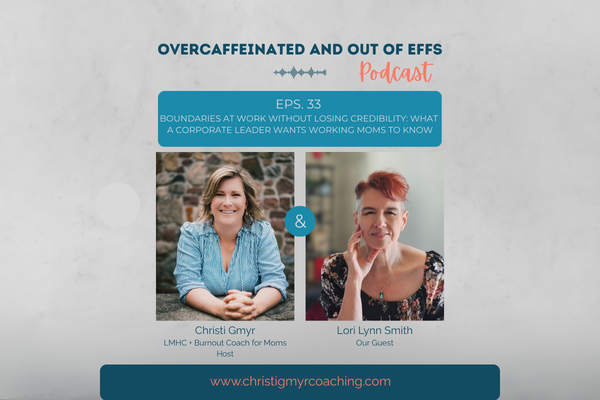
EPS 33. Boundaries at Work without Losing Credibility: What a Corporate Leader Wants Working Moms to Know
- Christi Gmyr Coaching
- Feb 17
- 30 min read
If you're a working mom who's stretched too thin and afraid that setting boundaries at work will make you look, “less committed,” this episode is for you.
Today on Overcaffeinated and Out of Effs I'm joined by Lori Lynn Smith, a corporate executive, strategies, and wellness guide who brings over 20 years of leadership experience managing multi-million dollar tech and strategy projects while raising four kids as a single mom. Lori has lived the reality so many working moms are in: impossible deadlines, blurred boundaries and the pressure to perform.
You've heard on other episodes about ways to set boundaries and take care of yourself at home, but today we look at the problem from another direction. Together we talk about burnout in the work place and how to avoid it by hearing insights from a woman in charge. Lori shares practical strategies working moms can use to:
set boundaries at work without losing credibility
communicate needs clearly and professionally
use boundaries as a leadership tool and not a liability
advocate for yourself in systems that weren't designed for working moms
understand how leaders and managers can better support working moms instead of pushing them closer to burnout
You don't have to choose between being respected at work and taking care of yourself. Boundaries aren't a weakness. They're a skill.
Lori Lynn Smith is a strategist, executive leader, and wellness guide who has lived the reality of burnout. A single mom of four while climbing the corporate ladder, she learned firsthand how chronic stress impacts women’s health, confidence, and careers. Now an MBA at 50 and founder of Flourishing Rebel and Strategy Rebel, Lori Lynn helps women build sustainable boundaries, protect their energy, and design careers and lives that actually support them — especially during midlife and peri-menopause.
Find Lori at:
[00:04] Christi Gmyr: Welcome to Overcaffeinated and Out of Effs, the podcast for burned out, career-minded moms who are ready to stop pretending everything's fine and feel like themselves again.
[00:15] I'm your host, Christi Gmyr, burnout coach for moms, licensed therapist and mom of two. And I'm here to help you reclaim your energy, your identity, and your peace of mind.
[00:25] Whether you're lying awake thinking about the 87 things you didn't get done or silently resenting the people you love most,
[00:32] This is your space to feel seen, supported, and not so alone.
[00:36] So grab your coffee, hot, cold or day old, and let's get into it.
[00:47] Hey everybody, it's Christi. Welcome to Overcaffeinated and Out of Effs. In today's episode, I'd like to welcome our guest, Lori Smith.
[00:57] Lori is a stranger, strategist, executive leader and wellness guide who has lived the reality of burnout. A single mom of four, while climbing the corporate ladder, she learned the hard way how stress can take its toll.
[01:09] Now an MBA at 50 and founder of Flourishing Rebel and Strategy Rebel, Laurie shares practical tools for managing burnout, building boundaries and supporting energy in peri-menopause.
[01:21] Her mix of corporate insight and real life stories gives women permission to design careers and lives that actually support them.
[01:29] So I've invited Lori here today to share her personal story and to talk about,[01:36] you know, use her corporate insight to talk about practical tools and strategies in the work environment that moms can use for managing burnout.
[01:46] So Lori, thank you so much for being here today.
[01:50] Awesome.
[01:50] Lori Lynn Smith: Thank you for inviting me. It's great. I've been listening to some of your podcasts, so I'm very excited to join the conversation.
[01:59] Christi Gmyr: Great. And I'm really excited to have you here.[02:02] I'm wondering if you can start off just by telling us a little bit about yourself, your family, your work, you know, just let us tell us a little bit about you.
[02:10] Yeah.
[02:11] Lori Lynn Smith: So right now I am a director at a medium sized software company.[02:19] As my day job and as my passion, I work with women on transforming their lives in various ways, health and, and work.
[02:29] I am a mom of four,
[02:32] two boys and twin girls. So life was always interesting when the,
[02:37] when the kids were small and,
[02:42] and now I'm a grandmom, so I have grandbabies as well. So I like to think about the fact that I am mentoring my son myself when I was in my 40s and that's how I like to like to think about it.
[02:58] It's like what do I wish that I knew in my 40s, and my daughters are now in their 30s. So what information do I want to pass on to them to hopefully make their lives a little bit better as they grow in their careers and start going through menopause and all those great things.
[03:16] Yeah.
[03:17] Christi Gmyr: So this idea really, that hindsight is 20 20. Right. It sounds like you're just kind of t. Looking back, taking all those experiences, all the things you.
[03:25] All the things you wish you knew, and you're using that knowledge and those insights to kind of pay it forward.
[03:31] Lori Lynn Smith: Yeah, 100%. 100%. And. And hopefully people can learn from it and not have to go through some of the struggles that I went through.
[03:40] Christi Gmyr: Yeah, yeah, no, absolutely. Well, and that's why we're here today. Right. Because unfortunately, there are so many women who are going through these struggles. Right. And we really just, you know, that's the goal is to kind of help support these women, you know, as they are managing these challenges.
[03:54] So,
[03:55] um, and just to kind of learn a little bit more about your story, your journey, you know, going back to when your kids were little and, you know, you were going through it all.
[04:05] What did those early years, you know, as a single mom of four, you know, you were climbing the corporate ladder at the same time. What did those things really kind of teach you about stress and survival?
[04:17] Lori Lynn Smith: That I didn't know one darn thing about it.
[04:21] That is for sure.
[04:24] That's for sure. I mean, I remember because I. I worked these crazy, crazy hours.[04:31] Um, and so I would be at work long before my kids went to school,
[04:38] and I would be calling them, you know, just before they had to leave for school and saying, okay, did you brush your teeth? Did you pack your lunch? Did you.
[04:46] And this was the time when it was like, cubicleville, right? So your co workers were, like, right beside you. I get off the phone and I'd hear from my coworkers, yes, mom, yes.
[04:59] Christi Gmyr: Oh, my gosh. So you are really dealing with, you know,[05:03] this additional challenge then, of, you know, moms are already juggling all these things. You're talking about being at work, like.
[05:09] Lori Lynn Smith: Hours before they were even out, before then one. And I've. I've had several because, you know, we never learned the first time. So I've had several different.
[05:20] Different sort of.
[05:22] Christi Gmyr: I won't.
[05:23] Lori Lynn Smith: I. I won't say breakdowns, but, you know, definitely hardcore hitting the ground situations. And definite.
[05:31] One of them was when I was.
[05:34] I would say the kids were in. In middle school,
[05:38] and I was sitting in my car in the parking lot.[05:43] It was 4:30 in the morning and I had left work at midnight.
[05:51] And I was just literally sitting in my car crying like, oh my gosh,
[05:57] what the heck am I doing? Like, this makes no sense at all. And at that time, I was a manager of nearly 250 people.
[06:06] Christi Gmyr: Wow.
[06:07] Lori Lynn Smith: Which is also insane.
[06:10] To have that many direct reports like that is just insane.[06:15] No one should be able.
[06:17] No one,
[06:19] no one could do that. Like,
[06:21] it's just not possible. Right. So that was definitely, for me, a breaking point. It was like,
[06:28] thankfully at that particular time, there was some. There was also a lot of political and instability happening in the organization and they made some changes. And I literally said,
[06:39] nope, not for me.
[06:41] I'm not going to be involved in that. Please lay me off, because no, I'm not going to make the transition with you. Good luck on your journey. But that's not me.
[06:52] Christi Gmyr: Okay, so it sounds like you had. Oh, go ahead. I'm sorry.
[06:56] Lori Lynn Smith: No, I literally had to do that. And I mean,
[06:59] I. I let. That is never what I would mentor someone to do, to do that. But literally that's where I was in that particular circumstance. It was like, I would rather quit and recover than continue on down that path.
[07:16] Christi Gmyr: Well, and so it sounds like, you know, you had all these experiences. It sounds like you knew you were struggling, you knew you were burned out. You know, you talk about this story about sitting in the parking lot crying, and it sounds like when this change happened at your job,
[07:30] you were sort of at a crossroads. Right. It sounds like you had the opportunity to go along with it, which you knew was. You just. It wasn't going to be a good move for you.[07:39] So instead you took the opportunity to go the other direction and make a change.[07:44] Lori Lynn Smith: Yeah. And sometimes you have to do that. Right. Sometimes there's circumstances where you can just change the circumstances without changing a role.
[07:54] Sometimes you have that flexibility, and sometimes you just have to choose to change the circumstances. Right. So.
[08:01] And, and every time that happens,
[08:03] because I feel like it happens many times in women's lives that that has to happen just because of how we're growing and maturing and like, we just know more than we did five years ago or even last year, honestly.
[08:16] Right. And sometimes you have to make that decision. And I think women need to be empowered that they can make that decision. They don't have to be stuck in those circumstances, and they have way more control over those circumstances than.
[08:30] Than people let on that they do. Right. I definitely don't recommend jumping without having a plan that you should not do. That you should have a plan because that just adds extra stress.
[08:45] You're not, you're not getting rid of your stress, you're adding more stress. So that's not a good thing.
[08:50] But yeah,
[08:52] yeah.
[08:52] Christi Gmyr: No, and I'm glad that you brought that up because I 100% agree with that. And that's actually one of the things,
[08:59] you know, initially when I had started, like my coaching, I was really talking about like career driven moms. Moms who are like very,
[09:06] you know,
[09:07] focused on moving forward in their career at that moment, wherever they were. And then I ended up like really sort of shifting it for that exact reason. Right. To sort of encompass all career minded moms at any stage.
[09:20] Because to your point,
[09:22] you know, we learn more, things happen,
[09:24] you know, life happens, circumstances change, our priorities change. And a lot of times we, you know, what was working for us at one time or was a good fit at one time just isn't anymore.
[09:35] Right. And so I love how you're talking about like, yes, we just need to be empowered and we, we do, we have that power to do that. So that's. I appreciate you bringing that up.
[09:45] Lori Lynn Smith: Yeah, yeah.
[09:47] Christi Gmyr: Well, and so at. Okay, and so now you are working, you know, you're leading, you've led these large corporate, corporate teams, you've managed these major projects.
[09:57] How do you personally see burn up, burnout showing up in women at work now today?
[10:04] Lori Lynn Smith: I think one of the biggest things is lack of self awareness.[10:11] Like,
[10:12] you have to know that there's a problem. And I think a lot of people,[10:16] they don't know enough about themselves to be able to see, okay,
[10:20] this is a slippery slope and I need to take action before you go sliding down that slippery slope and land on your butt on the ground. Right. And I think that all comes from self awareness.
[10:32] And it's. Sometimes it sounds like it's simple, but like just understanding what your core values are and what your boundaries are are so to me, fundamental things that
you need to know.
[10:47] Like where's, where are those lines?
[10:49] And lots of, lots of people don't know or they don't start investigating that until they're already in a precarious situation. Right.
[10:58] And having that awareness ahead of time helps people build the structures, the boundaries, the support systems that they need to be successful without going down that burnout path.
[11:12] Christi Gmyr: Yeah, yeah, no, absolutely. Well, and to go along with that, you know,[11:17] for women who recognize that boundaries are important, I think a lot of people recognize that they are important, but struggle with them for various reasons. To your point, maybe they're not sure where their boundaries are,
[11:29] or there could be some barriers, some fears, some sense of obligation, those sorts of things that can also, you know, prevent them from actually establishing and maintaining those boundaries.
[11:39] Lori Lynn Smith: Yeah.
[11:39] Christi Gmyr: Um, you know, and a lot of the listeners, you know, they feel like they can't necessarily set boundaries at work. I know that that's especially hard because of this fear of losing credibility, being seen as less committed, you know, not sure how their boss is going to respond.
[11:54] You know, what's. What is the response to that going to be? And so I'm curious, like, what are your thoughts about that?
[12:00] Lori Lynn Smith: There's a couple of different things or a couple of different paths that I think people can go down.
[12:07] So when I think when you're in a situation where,
[12:12] you know a boundary's been crossed and you're mad, upset,
[12:17] ****** off, like, do not talk to your boss at this time. This is not a time to talk to your boss about the situation.[12:24] Take the day, take the weekend, cool off,
[12:27] and, you know, really get your emotions back in check.
[12:31] And then have the conversation with your boss about this particular situation.
[12:35] There was a problem with this particular situation.
[12:38] This is how I'd like to resolve it.
[12:40] Uh, this is something I mentor with my team now.
[12:44] Do not come to me with your problems. Come to me with your solutions,[12:48] because I can help support your solutions. I cannot help your problem.
[12:53] Right.
[12:55] And it empowers people to find the solution that best works for you. Cause I can give lots of advice on what I think that solutions,
[13:02] solution should be, but that may not fit with you.
[13:06] So understand what the problem is, the root cause of the problem,
[13:10] not just the circumstance that caused the emotional deregulation,
[13:18] what's the root cause of that? And then have the candid conversation with your management about,
[13:24] okay, this is the situation that happened.
[13:27] This is where I feel like the issues are, and this is how I'd like to work at resolving those issues. So whether that is creating harder boundaries, having less meetings, et cetera, et cetera.
[13:40] Um,
[13:42] so I think that works in many situations. It also does kind of depend on the organization that you work for.
[13:49] 100%.
[13:50] Um, the other thing that I actually would recommend even more than that is make the change.
[13:57] Like, why do you even have to talk to your management about how you're going to act?
[14:03] You don't, Right? So, for example, let's say you have. You. You've just got a big to do list from your manager. These are all the things you have to do.
[14:14] And then tomorrow you get a big to do list from your manager. These are all the things you have to do.
[14:20] It's it. As long as you remain emotionally centered, it's very easy to say to your manager, your leader,
[14:28] okay, I have all of these things. Which one is the priority? Because I cannot do all of these in eight hours a day. Which one is your priority? Which one can be deprioritized and when a new one comes and once you start having that conversation with your leader, because I bet you dimes to dollars your leader doesn't know that you're,
[14:48] you're over capacity. Right?
[14:50] So just being frank about, okay, this is, these are my, this is, this is, these are all the things on my list which is the priority for you.
[14:59] And then say, okay, I will have this done in X hours, days, whatever, and then I will go on to the next thing. Just having that conversation with leadership goes a long ways.[15:09] The other thing is just do it. Like for example,
[15:15] let's say you put a boundary around meetings because definitely my job, my life is meetings.
[15:28] But what I've done is I've intentionally put time blocks in my calendar that is specifically for me to do my tasks and I just block my calendar. And so if a meeting request comes in, unless it is like an emergency emergency from the C level organization,
[15:47] it is, no, sorry, I'm not available at that time. I can be available at this time. And like we have mod on trails for that. Like one. If, if you're in a corporate situation where you have Outlook or Microsoft,
[15:59] it actually has an automated system in there where you can say book focus time and it automatically will do it for you. You don't even have to do anything about it.[16:10] And that gives you the flexibility to say, okay, I have the capacity to have an A Dexter meeting today or I don't have the capacity and my calendar's already blocked so I don't have to worry about it.
[16:22] And then just give your recommendation for I'm available Tuesday at 10am Right.[16:27] You don't have to, you don't have to be negative about it. You just have to state the facts. I am not available at this time. I'm available at this time.
[16:35] And that's something you have 100% control over in 90% of the circumstances, which will get you so much further ahead on creating those boundaries.[16:49] Yeah.[16:52] Christi Gmyr: Well, and then the other thing that I'm wondering about, you know, in regards to boundaries. So you're, it sounds like you're talking a lot about, you know, work specific tasks in a work day.
[17:02] And obviously there are Different. There are strategies and things like that around setting boundaries at home. But I also am thinking about,
[17:10] for working moms, the overlap between the two. You know, I think a lot of moms find themselves in situations where there are conflicts,
[17:19] and maybe they want to be prioritizing their families or their kids, but they feel obligated to be prioritizing work. And again, I realize that this is specific to your point to the company, but how would you suggest sort of bringing some of those things to your supervisor?
[17:35] Things such as,
[17:36] you know, I need to leave early because my child has this thing, or I can't come in today, I have to work from home because my child is sick, or, you know, those overlap things.
[17:45] What's more about the home life than the business life?
[17:48] Lori Lynn Smith: And I think, you know, I mean, thank goodness things have mostly changed in the last 20 years, because definitely when,
[17:56] when I was. When my kids were small,[18:00] there was much less flexibility than there is now. Just in general. Like, I. I remember a time when my son had appendicitis and he had to have surgery and he was in the hospital for like five days or something.[18:13] And his dad and I literally took turns. Okay, you go to work today, you stay.
[18:20] You stay at the hospital.
[18:22] And we did that, and we had to take vacation days in. In order to do that. Right. So thank goodness things are changed now.
[18:31] Um,
[18:32] so I think having that we definitely have. I feel like just in corporate in general, we definitely have a lot more flexibility and more people are aware,
[18:43] but it, it does depend on the company.
[18:46] Um,
[18:48] I, I would say, like,
[18:51] I really appreciate the company that I work for right now, which is very flexible. I mean, it helps us, a software company, so it's very flexible with how people work.
[19:02] And we have a great cross section of males and females, almost 50, 50 Rachel, which is excellent.
[19:11] And we always have the flexibility of, oh,
[19:15] a doctor's appointment, whether it's yourself or your kids or,
[19:19] oh, I have to go pick. Pick up my kids from daycare, et cetera, et cetera. And the conversation with management about that is tricky when it's in a situation where the company just doesn't have that flexibility,
[19:33] which is unfortunate and hard to handle. But I think it's just a forthright conversation. And sometimes there has to be a compromise to it. Right?
[19:44] So hopefully they're not asking for PTO time, but sometimes that is part of the trade off. It's having that very open conversation with what is happening with your particular organization.
[19:57] And the only way to do that is that conversation. I think Often we assume, oh, my company's not going to do this.
[20:04] And they don't have that conversation with their, their leadership team to actually ask.
[20:11] Right.
[20:12] It's. People make assumptions instead of having the conversation. Because it is a hard conversation to have. Right?
[20:20] Christi Gmyr: Yeah,
[20:21] yeah, absolutely.
[20:23] Well, yeah, no, and to your point, I mean,
[20:27] until you have the conversations, that's exactly. You don't know those assumptions. Right? I, I mean, exactly. You don't know. Right. You might have an idea or I guess, but until you haven't, like, you really just don't know.
[20:37] Lori Lynn Smith: Yeah.
[20:37] Christi Gmyr: You know, and so coming back to something that you had said, you know, a few minutes ago about how a lot of times, you know, leaders and managers, they just, they don't even necessarily know when people are struggling,
[20:49] you
know. So I'm curious, you know, for the,
[20:52] for the people who are listening, who are leaders,
[20:54] what are some things that they can do to better support the moms on their teams?[21:01] Lori Lynn Smith: You know, I, I feel very strongly.
[21:04] Christi Gmyr: That.
[21:07] Lori Lynn Smith: They have to be having the one on one conversations with their team,
[21:11] but not from the perspective of what work they're doing, but like, how is their life going? Like that needs to be part of it. I'm a firm believer in that.
[21:22] Having those one on one meeting.
[21:24] For me,
[21:25] building relationships is the most important part of leading.
[21:30] Because if you don't know your people, you don't know. You can't. Like, you need to really understand your people in order to help them be as successful as possible.[21:41] So having those one on one conversations where you are building the relationship with them so that when you have to have a hard conversation,
[21:50] whether it's from their side or from your side, you already have a really solid relationship. You understand what's happening in their lives inside and outside of work. And you can make decisions or plans together that will support that.
[22:06] And that's individual for every person on your team. You can't make an assumption that just because this person, this is happening with this person that that's going to be true of everybody because everyone will handle that situation differently.[22:21] Does it take time as a leader? 100% it does. But it's also worth it because you can find out if there's any issues or problems way before they start impacting the workload or your team or all of those things ahead of time.
[22:41] Christi Gmyr: Well, it sounds like it's really good time invested, essentially. Like, yes, it takes time, but you're setting yourself up for success down the road.
[22:49] Lori Lynn Smith: Yeah, yeah, yeah.
[22:51] Christi Gmyr: No, that, that makes sense.
[22:53] Lori Lynn Smith: Yeah.
[22:53] Christi Gmyr: Oh, go ahead.
[22:55] Lori Lynn Smith: No, it's just something I believe in strongly. And yeah, it does take time, but it's, it's, it's worth it. 100%. It's an investment, right?
[23:03] Christi Gmyr: Yeah,
[23:04] yeah, yeah, absolutely.
[23:06] Well, so then what would you say are some of, you know, when we talk about burnout recovery and we talk about self care, what would you say are some of the biggest misconceptions that you see around those things?
[23:19] Lori Lynn Smith: That self care is a bubble bath?
[23:23] I mean,
[23:24] it is. I mean, it can be,
[23:27] but it's not really about that from my perspective. It's about creating the boundaries that you need and the systems that you need and the support that you need more than anything.[23:41] Right?
[23:42] Like what's happening,
[23:44] what's happening in your, you know, immediate circle? Because it's not just you, it's your family.
[23:50] It's like how, how is your partner or your spouse helping in this situation?
[23:57] How, you know, it's, it's not just that one thing. It's that whole support system you have. And like, do you,
[24:05] and honestly, do you have women friend that, friends that you can talk to and communicate with?
[24:10] Do you have a coach? Like, these things are super important to support you through these sort of circumstances, right? There's tons of science behind the fact that women need women's support.
[24:25] And that's, that's an important part of this, of this role, right. Is to, is to do that.[24:32] So to me, it's about the self awareness, knowing where,
[24:38] where you are challenged,
[24:40] creating those boundaries that really are important,
[24:44] working with your support system to give you that support that you need to go through this. And it's there.
[24:51] Just because you're not asking for it or talking about it doesn't mean it's not there. It is because if you're a leader at work or if you're working towards being a leader at work, asking for help is one of the hardest things to do.
[25:07] But it is the, one of the best investments that you can make. So maybe it's not at work, maybe it's outside of work, maybe it is peers,
[25:17] you know, your, your women friends that are maybe your mom group or maybe there's a women's leadership group that,
[25:26] that can be supportful. But, but finding that is like it's 100%.
[25:33] Yeah. And, and well, and honestly, you know.
[25:38] Christi Gmyr: And I was just going to say, you know, when I talk and I agree with you 100%. And one of the things that I find happens for a lot of moms, you know, they talk about this idea of like not wanting to Burden other people, things like that, you know,[25:48] those sorts of reasons, sort of preventing them from asking for the support. But when they.
[25:54] When they challenge themselves to. To do it,
[25:57] what they more often than not are finding that that's not what's happening. Right. And a lot of times the people who are offering that support appreciate being asked. They want to offer that support.
[26:07] Lori Lynn Smith: Right.
[26:08] Christi Gmyr: Because it's. It's all about sort of building and leaning on that community.
[26:13] Lori Lynn Smith: Yeah, 100%.
[26:14] Christi Gmyr: I do.
[26:15] Lori Lynn Smith: I do think, though, that we have to make sure that it is a community that is supportive and not just letting you vent.
[26:26] Because if you spend all of your time venting about all of your problems, you're staying stuck in your problem by repeating it over and over and over again.
[26:37] So you really have to make sure that that support system that you're working with is helping you to move out of that. So, yes,
[26:46] vent about it.
[26:48] Get. Get done with it. And then what's the next step? How are we going to fix you? How can I support you to move to the next step?
[26:56] That's the kind of community that you need to have because it's there and it's a tough.
[27:02] Christi Gmyr: That's a really good point.
[27:05] Yeah. Yeah, no, that's a really good point. And I also think about, you know, when people do start venting and maybe they're not getting the kind of support that you're describing,
[27:14] especially if it's a group or several people, sometimes it can become a bit of an echo chamber. And to your point,
[27:19] then. Then it's. Then it can actually make the emotions run higher. Right. Rather than actually helping you move through it and get to a better place.
[27:27] Lori Lynn Smith: Yeah, that's why I think.
[27:29] Christi Gmyr: Absolutely.
[27:29] Lori Lynn Smith: That's why I think it's good to have.
[27:31] So I mean, it's great to have your friends, like the friends that you've known from high school or college or whatever. It's great to have those. But those tend to be the ones where you become that echo chamber.
[27:43] Christi Gmyr: Because.
[27:43] Lori Lynn Smith: You know, you tell the same stories. Like you remember that time in college,
[27:47] you know, you tell the same stories over and over again. Right. So I think it's important to find something outside of that where you can build new relationships with new people that are going in the same direction that you're going in.
[28:01] Right. So you're. You're all here at this place and you're all moving to that next plays,
[28:09] and that really, really helps move. Move that along. Right. Because they'll be a little bit more about. Okay,
[28:18] they'll be A little bit more candid. Okay. You've told this story for the past three weeks.
[28:23] Like, what are you doing to change this story now? You're not going to get that from your girlfriends from college, right?
[28:29] You're gonna get that from a different kind of group, right?
[28:36] Christi Gmyr: Yeah, yeah, no, absolutely. And I, like I said, I think that that's a fantastic point because that's something that we do. Everybody talks about support, but they don't necessarily talk about like, what that really needs to look like to actually be, be helpful and be supportive and, and moving out of those problems.
[28:52] Lori Lynn Smith: Yeah.
[28:52] Christi Gmyr: So another thing that I know you talk about is this idea of burnout as an energy.
[28:58] I'm wondering if you can tell us a little bit about what that means and how moms can use that in their daily lives.
[29:05] Lori Lynn Smith: Yeah, for sure. I like to, I like to use the analogy of your bank account.
[29:11] So we all know,
[29:13] we might not like it, but we all know how the bank accounts work.
[29:18] Your paycheck goes in and all your expenses go out.
[29:21] Yes, but, but if we think about energy in the same way, we only have a battery that's like,
[29:28] that can be 100% like, that's our full battery. Right.
[29:32] And every, every action that we're doing every day is either adding to that energy or taking away from that energy.
[29:42] So this is really part of that self awareness. What's happening in your life that is allowing you to add energy.
[29:48] Maybe that is a bubble bath or maybe that is just your, your spouse or partner or your parents or another trusted person taking your kids for an hour so that you can have some me time that's adding into the bank.
[30:04] Christi Gmyr: So what?
[30:05] Lori Lynn Smith: And it, again, this is specific to every person. Right. So some people reading a novel for an hour is a huge plus to their energy. Right. Some people, it's like going for a run, whatever that is.
[30:18] What is that for you?
[30:20] That adds energy to your battery bank?
[30:23] And then what are those things that are taking away energy from your battery bank and then assessing what those things are and what can you do to reduce those or decrease those in some way?
[30:39] If it's at home,
can you Delaware delegate to the kids to, you know, vacuum the, the playroom or your partner to throw a load of laundry in if it's at work,
[30:51] Is that possible?
[30:53] You know, is having that conversation with your boss? I really don't have time for this particular activity. Is there someone else on the team that can take it? So just evaluating what things are happening in your life that are taking away from that Energy and what can you do to remove that?
[31:11] And even if you just think about one thing a week even, okay, what's adding to my battery bank, what's taking away that I can remove at this time.
[31:20] And Obviously that is 100% different. The time of year,
[31:25] what stage you are in your life, how old your kids are. Like, it's, it's a constant awareness of those things that are adding, subtracting from your energy level.
[31:38] Because burnout is running at zero.
[31:41] Yeah, running at zero.
[31:43] Christi Gmyr: Yeah, yeah,
[31:44] yeah.
[31:46] Well, and to your point, I mean, even if it's just like one small thing, you know that that can still make a difference, right? It's still 100% still progress, you know.
[31:56] Yeah, yeah. Well, and so another thing that you talk about, you know, you talk about these 10 minute resets, you're telling these micro rituals,
[32:04] and I'm wondering if you can talk a little bit more about those. Like what would be some.
[32:08] For starters, what do you mean by that? And then also just maybe share an example or two that you know, busy moms could,
[32:14] it would actually work for them when they really just don't have this time for themselves.
[32:18] Lori Lynn Smith: Yeah, I mean, let's face it,
[32:20] we don't have time. So that's kind of the point around the 10 minute because like either you have a meeting or you have a screaming kid, right? So like there's not a lot of time for stuff.
[32:32] Like,
[32:33] so it's just the whole concept of it doesn't need to be an hour,
[32:37] it can be just 10 minutes.
[32:40] So for example,
[32:42] I am in the middle of my workday today and I'm talking to you. So it was like, okay, I just, I had just had this very heavy strategic meeting with a whole bunch of directors at my client's customer.
[32:55] And I had 15 minutes to switch my mindset from that to having this conversation right now.
[33:02] Um, and so what I did was one of my 10 said it,
[33:06] 10 minute resets is one. I just walk to my living room because luckily I'm working from home right now. But so it's walk around the office.
[33:15] In my case, I walk to my living room and I have a mini trampoline. So I literally just bounced on my trampoline for five minutes and then I took the next three minutes before we started our conversation about doing parasympathetic breathing, which is very simple.
[33:37] It is just for to count to four to breathe in and then count to six to breathe out. And it's that the difference between taking longer to breathe out than to breathe in that calms your Paris parasympathetic nervous system.
[33:55] And you can do it in two minutes, literally between meetings, or when you go to the bathroom and your kids are screaming outside.
[34:03] It's just little activities like that that allow you to take back control of the emotional deregulation that is happening. Or even just switching from task to task. Like oftentimes when we are transitioning from work to home or home to work,
[34:25] there's that it's hard. Like you're driving home or you're taking the train home and you're still thinking about work. Still thinking about work. Right.
[34:34] So it's that having that five minutes or ten minutes of okay,
[34:40] either I'm sitting in the garage and I'm deep breathing before I go in. I'm like calming myself, I'm changing and.
[34:48] And it's making that transition. But there's lots of really cool things that you can do as well.
[34:54] Um, you can do these kind of weird shaking exercises and stuff where you shake your entire body. And again, it works on the parasympathetic system and it just calms you down and it allows you to make clean transitions.
[35:08] Um, it could be listening to your favorite power tune. Like I have a playlist in YouTube, which is like my power power songs, and you just have to play one or two of those.
[35:19] So that's like less than five minutes.
[35:21] And you just pick the right song that is for that particular situation. Right. Either amps you up or calms you down.
[35:30] Music is so easy one to do. You have it on your phone, you have it on your computer. It's like right there.
[35:38] And it can make switching your emotions at that time or mood at that time super simple.
[35:46] So it's really easy. Things like that.
[35:51] Christi Gmyr: Well, and one of the great things, I mean, obviously something like a mini trampoline that might be. That's something that, you know, there are certain things that are maybe only going to really be done at home.
[35:59] Right. But one of the things that I like about when you talk about like breathing and shaking your body and the music, like, there are lots of things that you can do in the work environment too, in your office or whatever.
[36:10] So, yeah, you don't have to be restricted because you're not at home.
[36:15] Lori Lynn Smith: Yeah. I. I would think the shaking part you should probably go do in the ladies washroom or a closed door in your office. Or a closed door in your office if you have one.
[36:26] Or just taking a walk around the building, like that's enough too, right. Like, you know, back in the Day, this doesn't happen as much anymore. But back in the day, like lots of people take smoke breaks.
[36:36] And it's like, I've seen some memes on,
[36:39] on Instagram now where it's like the smoke bake break is a bubble blower.
[36:45] Which interestingly enough,[36:48] blowing the bubbles from a bubble blower is using the breathing techniques of the parasympathetic nerves. So, I mean, you don't necessarily have to blow the bubbles, but the concept is still the same.
[37:00] Take that five minute break. You deserve that five minute break. Right?
[37:05] Take that five minute break, go outside,
[37:07] walk around the building,
[37:08] come back. Or if the weather's inclement, like I live in Canada, so half the time it's snowy outside,
[37:14] take the stairs. Like, if you're going from a meeting to a meeting, take the stairs instead of the elevator. That gives you that five minutes to reset between meetings. It can be very simple.
[37:28] Christi Gmyr: Well, and to your point, I mean, you absolutely, you deserve that break. And on top of that, having that break, it benefit, like it benefits you, but it also benefits,
[37:37] you know, your employer benefits because it makes you more productive. It makes you just, you end up just being able to move through your day so much more effectively when you take those few minutes for yourself back to that time invested.[37:51] Right. And so maybe it's five minutes, but what are you gaining back by taking the time to do those things?
[37:57] Lori Lynn Smith: Yeah. The other thing is too, it's not something you need to talk about, to talk to your manager about, your boss about. It's like it's a five minute break.[38:04] Christi Gmyr: Yeah, yeah. Like, no, absolutely.
[38:07] Lori Lynn Smith: Like you have control. You have control of that, right?
[38:10] Christi Gmyr: So yeah, no, absolutely.
[38:12] So, you know, when you had first started talking today, one of the things you were talking about is how, you know, you've moved through, you know, your child raising years, now you're a grandma, right?
[38:21] And you are looking back,
[38:23] you know, at all the things that you've learned. And so with that in mind, I'm curious, like, looking back now,
[38:30] what is something that you wish somebody had told you about being a working mom before it got to the point of burnout?
[38:38] Lori Lynn Smith: That you don't have to do it all. You can, you can have it all, but you don't have to do it all. Right. Like,
[38:45] I think, I mean, and I'm just generally an A type personality, which is not great. Like, you know, I used to be the person that was like, well, just let me do it, I can do it better than you.
[38:55] Like, I've really had to learn that.
[38:58] Christi Gmyr: I think a lot of people can relate to that.
[39:01] Lori Lynn Smith: It's really, it's fine if someone else does it. And it's, it's,
[39:06] I mean we, we deal with this a lot in software. Like it's never going to be 100%,[39:12] never going to be 100% and you just have to be okay with that. And that takes a lot of mind shifting change to be able to do that.
[39:22] And it took me many years to figure that out is like,
[39:27] it doesn't have to be perfect.
[39:29] There's no one,
[39:31] no one judging you on that. Right.
[39:34] And I also think that often,
[39:37] especially when we're younger,
[39:39] we get caught up in.
[39:41] My problems are so big.
[39:43] And because you're not sharing it with your circle,
[39:48] you don't understand.
[39:49] Many,
[39:50] many other women are in the same circumstance as you are and there are resources available to,
[40:00] to support you through the, through that particular time, especially when your kids are young. Right. Because women often have the heavier child raising burden when the kids are particularly small.
[40:12] It's changing now, which is awesome. It's great to see, but it's still, you know, still weighs a little bit heavier on the, on the woman's side of things.
[40:23] Christi Gmyr: So.
[40:24] Lori Lynn Smith: But there, there, there are literally hundreds and thousands of women that are in your particular circumstance as well. And just realizing it's a village. There's lots of people
in your circumstance.
[40:36] You're not alone in this and there's help available.
[40:40] Christi Gmyr: Yeah,
[40:43] yeah, no, definitely.
[40:45] Well, so I have to say this is just,
[40:48] I feel like I could keep talking to you all day long. You just seem like you have so much knowledge and experience and you are just so easy too.
[40:56] Unfortunately, you know, we are getting to that time. We're going to have to start wrapping up in a couple minutes, but before we do, I'm wondering where can listeners go to learn more about you and your work?
[41:07] Lori Lynn Smith: So there, there's a couple of places that are super easy to find me and one is LinkedIn for sure. I have, I am posting lots on LinkedIn and having lots of great conversations on LinkedIn and then my personal website.
[41:22] LoriLynnsmith.com.
[41:26] Christi Gmyr: Yeah, okay, so I will.
[41:29] All right, thank you. And I will make sure that those are included in the show notes for, for anybody who wants to, you know,
[41:36] look you up or learn more about you and the work that you do.
[41:39] Um, and so before we, you know, before we do wrap up,
[41:43] if you could leave the moms listening with one final piece of advice, one final message, just one more thing that you would want them to know what would it be?[41:54] Lori Lynn Smith: Oh, so many things. So many things.
[41:57] It's hard to pick just one.
[42:00] I think one of the big ones is you're not behind.
[42:06] So it's not a race. You're not behind.
[42:09] You're exactly where you need to be.
[42:12] You're becoming the woman that you're supposed to become.
[42:16] And even though it seems like things are a challenge right now, these are the things that are building you into the woman that you're going to be super proud of one day.
[42:29] Christi Gmyr: I love that, you know, because I'm thinking about all the women who are just in this Go, Go, Go state all the time, constantly trying to tackle their to do list, constantly trying to catch up on everything.
[42:41] Right? And so I just. I love that, and I think that that is a great thing for them, for them to hear. So thank you for sharing that.
[42:50] So, again, I feel like this has just been so wonderful, and I really appreciate you taking time out of your day to come talk to me. So I just, you know, thank you again so much for being here.
[43:00] And as always, for the moms who are listening, if any of this is helpful, valuable, if you resonated with any of it, please share this podcast with other moms that could maybe use some additional support.
[43:11] As Lori said, there are lots of them, you know,
[43:15] and we really just want to be able to support everybody the best we can because we are all in this together.
[43:21] Lori Lynn Smith: Yeah. Perfect. Thank you so much for having me today.


Comments